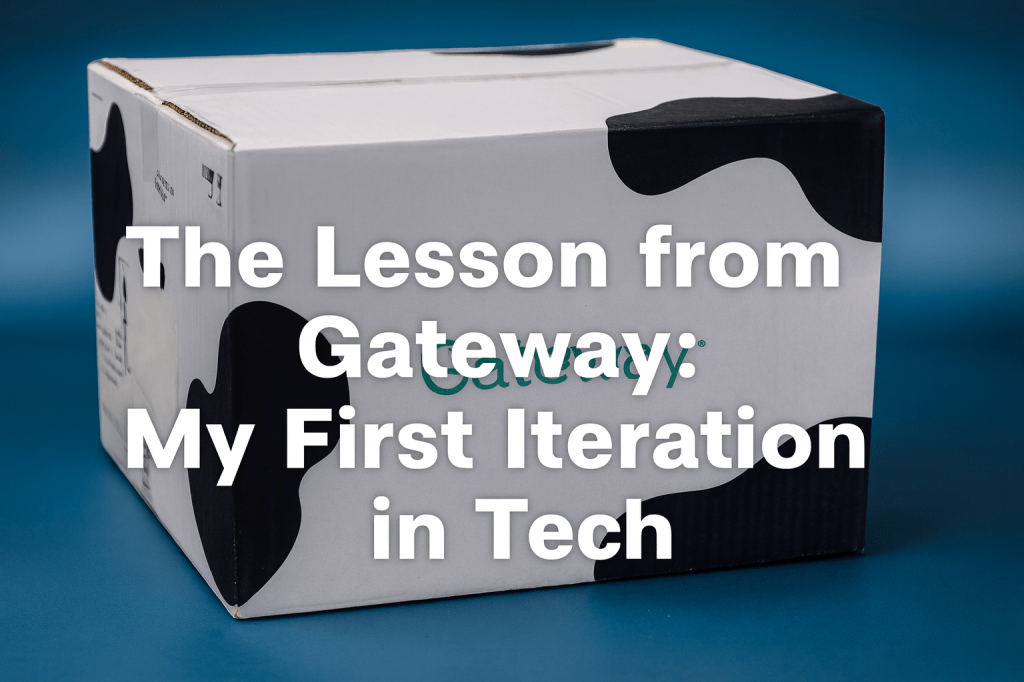
In the mid-1990s, I was in my early twenties, standing at the intersection of ambition and opportunity. I had left college, eager to start working and be part of something real — something that mattered. That’s when I joined Gateway Computers, a company that, at the time, was changing the way people thought about technology.
For anyone who doesn’t remember, Gateway was one of the most iconic computer companies of the era. The logo — those black-and-white cow spots — was everywhere. Gateway built machines that could compete with the best, and their commitment to customer service and innovation was unmatched. The company wasn’t just selling computers; it was selling access to a new digital frontier. For someone passionate about technology and eager to learn, it was the perfect place to be.
The Promise of a New Frontier
When I joined Gateway, it felt like walking into the future. The energy on the floor was electric — the sound of phones ringing, techs troubleshooting, and the buzz of people who believed they were part of something special. It was a place where innovation felt tangible, where everyone wanted to be the next success story.
I wasn’t just working a job — I was building a career. And like many others at Gateway, I bought wholeheartedly into the company’s vision. So much so, in fact, that I began investing over 60% of my biweekly paycheck into company stock, offered to employees at a discount. The logic seemed sound: the company was thriving, my colleagues were prospering, and early employees had already become millionaires. It wasn’t just a company — it was a movement, a modern American dream fueled by technology.
I remember looking at the people in the glass offices above the main floor — the ones with the corner windows and reserved parking spots. They had made it. They’d started on the floor like me, but through dedication, risk, and belief, they’d risen to the top. I wanted that life. I wanted to be one of them.
When the Momentum Shifted
But in technology, as I would soon learn, momentum can shift in an instant.
Not long after I started heavily investing in the company, Gateway announced major financial losses. The tone changed almost overnight. The same managers who had once spoken about growth and expansion now held emergency meetings about cost control and restructuring. The rumors began: layoffs, downsizing, reduced benefits. For a while, many of us refused to believe it. We told ourselves it was temporary — that a company as strong as Gateway couldn’t possibly fall apart.
Then the layoffs came.
One by one, friends, mentors, and colleagues disappeared from the floor. Some packed their boxes quietly. Others left bitter and angry. The once-lively workspace started to feel hollow — a shell of what it had been just months before. The optimism evaporated, replaced by a nervous silence and the haunting awareness that the future we’d been sold might not arrive after all.
When the dust settled, over 75% of the workforce had been let go. The company’s stock — the same stock I had poured so much of my hard-earned paycheck into — plummeted to nearly a third of its original value. It was painful to watch those numbers drop, not just because of the financial hit, but because of what it represented: broken trust, misplaced faith, and the end of a shared dream.
Eventually, Gateway was acquired by Acer, a company many of us had once laughed off as a lesser competitor. The irony wasn’t lost on any of us who had believed Gateway would last forever.
The Hard Lesson
That experience left a mark — not just on my finances, but on my perspective about technology, business, and leadership. It taught me that even the strongest companies, filled with the brightest people and the best intentions, can falter. Markets shift, innovation stalls, competition catches up, and sometimes, despite all your effort and belief, the world changes faster than you can.
More importantly, I learned that those of us on the floor — the builders, the coders, the problem solvers — often have little control when those seismic changes hit. We keep the lights on, but we don’t always steer the ship. That realization was humbling. It reminded me that loyalty to a company should never come at the expense of adaptability, and that the most important thing you can invest in isn’t a brand — it’s yourself.
A Shift in Thinking
Looking back now, nearly three decades later, I can see how that early experience planted the seeds for the next stages of my career. At the time, it felt like failure. But in hindsight, it was a lesson in resilience — an early “iteration” in understanding how to navigate change.
I stayed in technology, moving from help desk support to software development and later into IT leadership. But I carried that Gateway story with me everywhere I went. It shaped how I led teams, managed projects, and thought about risk. I learned to question assumptions, to look at the long-term health of an organization, and to always have an eye on what’s next.
And “what’s next” has now brought me here — to a new chapter.
The Next Iteration
At 55, I’m once again standing at the edge of change. This time, the disruption is coming from artificial intelligence — a force every bit as transformative as the rise of personal computing in the ’90s. The difference is, now I understand how to navigate it.
Instead of fearing AI, I’m fascinated by it. It represents both the unknown and the opportunity — much like Gateway once did. But this time, I’m not just betting on a company. I’m betting on adaptability, learning, and the human side of technology.
That’s what The Next Iteration is about: documenting my journey as I transition from decades of software development and IT leadership into Agile project management and AI exploration. It’s about examining how we, as professionals and as people, continue to evolve — how we can bring our experience forward while staying open to entirely new ways of thinking.
AI won’t replace experience. But it will redefine how experience is used. It will challenge us to work differently, to think more creatively, and to lead with both empathy and data. I see it not as a threat, but as a partner — an amplifier of human capability when used with care and purpose.
Full Circle
When I think back to my days at Gateway, I realize that what I really loved wasn’t the company itself — it was the feeling of being part of something new, something innovative. That sense of discovery is what has always driven me, and it’s what continues to drive me now.
Losing so much during those Gateway years taught me the dangers of complacency and blind faith. But it also taught me the value of curiosity, reinvention, and humility — qualities that are essential for navigating this new era of AI-driven transformation.
So this blog, The Next Iteration, is more than a story about technology. It’s about adaptation — about learning from the past, embracing the future, and reminding ourselves that change isn’t something to survive; it’s something to shape.
I may have started my journey surrounded by beige computer towers and CRT monitors in Sioux Falls, South Dakota, but the lessons from that time still guide me as I explore neural networks, agile frameworks, and digital leadership today. The technology has evolved, and so have I.
And that, in itself, is the truest form of iteration.
 The Next Iteration